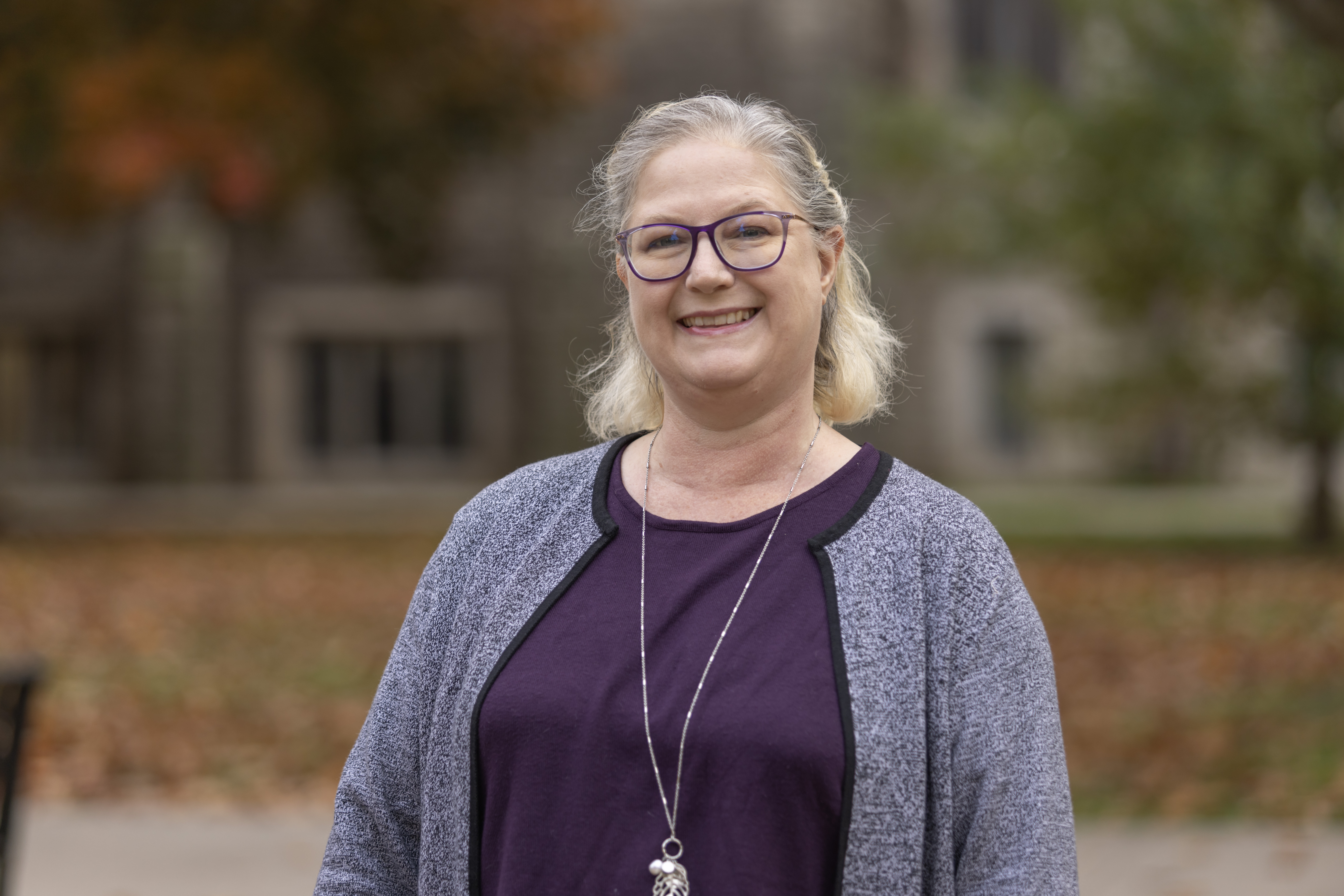
Cathy Grisé is passionate about helping students learn through hands-on, experiential opportunities that bridge the classroom and the world beyond university.
A medievalist by training and an associate professor in the Department of English and Cultural Studies, Grisé has been part of McMaster University since 1999. She is committed to interdisciplinary learning and believes that digital scholarship gives students the chance to develop practical, real-world skills.
She was drawn to the Sherman Centre for its collaborative, solutions-driven environment, and its mission to make research and learning more accessible to everyone. Her appointment as its academic director was approved by McMaster University's Senate and Board of Governors. The role officially started on Nov. 1, 2025.
We spoke with Grisé about her goals for this role, the value of the Sherman Centre’s work, and how her expertise in English and cultural studies will support her mission.
For those who may not be familiar, how do you describe the Sherman Centre?
The Sherman Centre supports faculty, students, staff, and even community members in all aspects of digital scholarship. Our goal is to help people build digital skills through training, consultations, and workshops, and then apply those skills in their own work or classrooms. That could mean helping a researcher figure out how to manage their data, working with a class that wants to integrate digital tools, or meeting one-on-one with a grad student to solve a problem in their project. The Centre also runs a graduate residency, an invited speaker series, and an undergraduate course.
What does your role involve?
As the academic director, I’ll oversee two main areas: the postdoctoral fellow and the graduate residency program. I’ll also help plan workshops and training, though that’s very collaborative. My role is more about the big picture: setting direction, mentoring, and building connections across campus.
How does your background in English and Cultural Studies connect to this work?
Seeing my own undergraduate and graduate students navigate the pressures of making their humanities degrees relevant really highlighted the importance of experiential learning. One memorable project involved students in a medieval course working in local schools while connecting that experience to course readings. They valued applying what they were learning, and it was a switch-flipping moment for me. Experiences like this show how digital scholarship and hands-on opportunities can equip students with skills they’ll use well beyond university.
Why is the Centre’s work important for the McMaster community?
I think the Sherman Centre’s work ties into a few key things at McMaster: experiential learning, interdisciplinarity, and collaboration. Experiential learning has always been part of McMaster’s strength, and it’s just as important in humanities and social sciences. The Centre gives students and faculty opportunities to learn by doing, experiment with new tools, and apply their skills in practical ways. Collaboration is another big part of it. As humanities faculty and students, we sometimes work in our own bubbles, but life is group work. Some of my best experiences here were when people from different areas came together to solve a problem. That collaborative spirit is really at the heart of the Sherman Centre.
What are your goals for this position?
One of my main goals is to increase awareness of the Sherman Centre and build capacity across campus. Students, faculty, and staff all have so much on their plates, so I want to make it easier for people to find the support and training they need. I’d also like to explore new ways of reaching people. Longer workshops and boot camps are great, but maybe we can package some of that learning into shorter, more accessible formats to help busy students and faculty get excited about what we do. And of course, there’s generative AI, which is changing how we think about teaching and research. I’d like the Centre to help faculty navigate that change with both practical resources and encouragement. Sometimes a bit of “we’ll figure it out together” support goes a long way.
What does digital scholarship mean to you?
For me, digital scholarship is about access and exploration. It’s about preserving and sharing stories, especially from voices that haven’t always been heard. In my own work, for example, I’ve been looking at 15th-century religious texts written by women and tracing how their writings traveled into the New World and influenced different communities. Tracking manuscripts across libraries and connecting related texts was overwhelming at first, so I started experimenting with digital tools like databases and data visualization. These tools let me see patterns and relationships I couldn’t hold in my head, like which words or symbols appear across texts. That sense of discovery, of exploring and experimenting, is what I love about digital scholarship. It’s about making materials accessible, giving people the tools to see connections, and opening up knowledge to wider audiences.
What is the value of the Sherman Centre for students?
For students, the Sherman Centre is an amazing place to learn digital tools. The skills you gain here can be a real add-on for whatever you plan to do after university. In today’s job market, it’s so important to find ways to set yourself apart, get extra skills, and explore new opportunities. The Centre is right here in Mills Memorial Library, ready for students to come in and see what they can create.