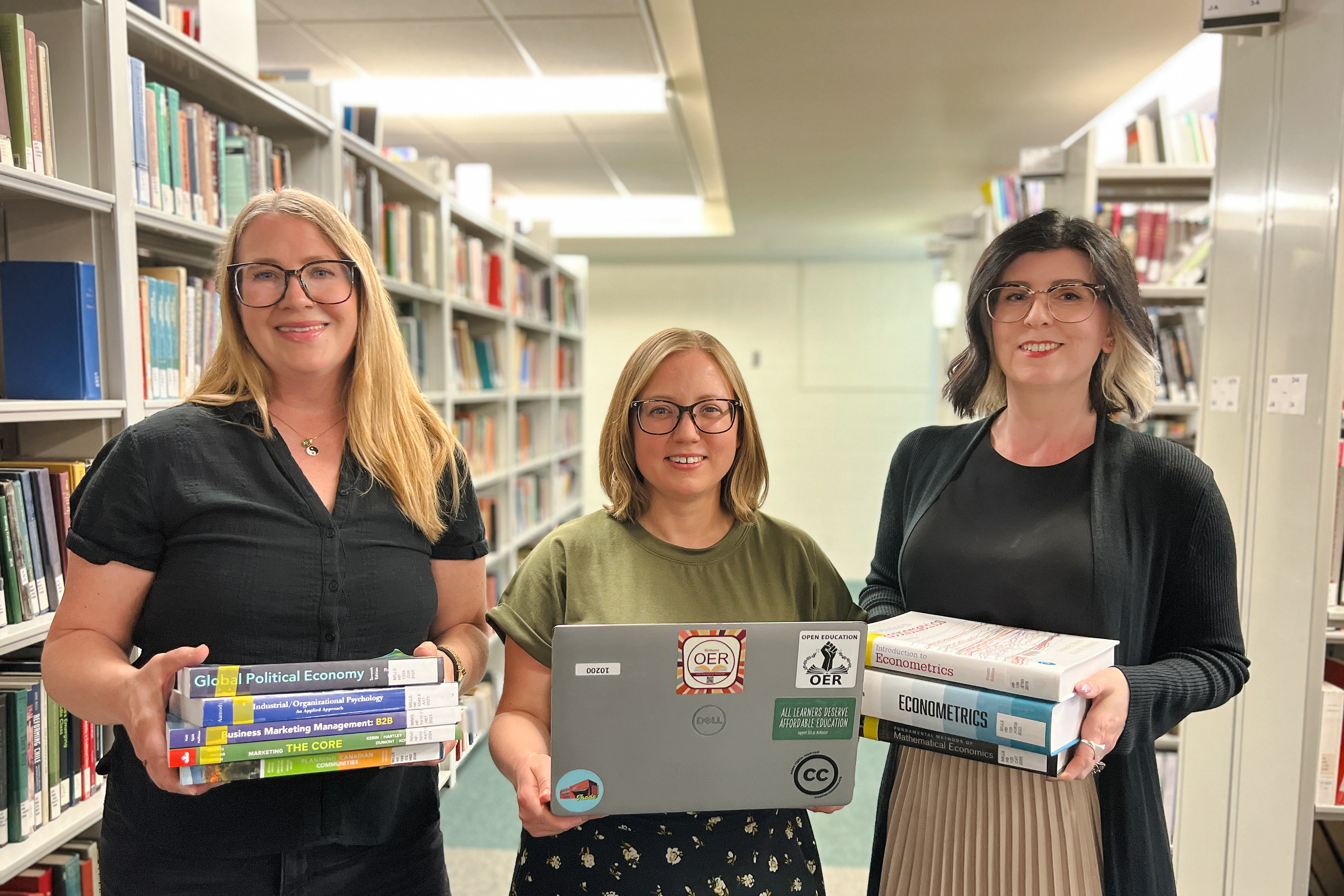
As instructors select course materials for the upcoming academic year, McMaster University Libraries offer services and support to help make course materials more affordable for students.
The libraries provide flexible options to align with course goals, including eReserves, open educational resources (OER), and expanded access to required texts.
This work builds on the libraries’ long-standing efforts to develop tools and services that improve student learning outcomes.
"Thank you to the libraries for taking steps to support student affordability,” said Kim Dej, vice-provost (Teaching and Learning). “I encourage instructors to take a look at the options available. You don’t need to change everything. Even a small or incremental change can make a big difference to learners.”
eReserves: Flexible reading lists
eReserves is a one-stop access point for course reading materials free for students to access, all centralized within Avenue to Learn. eReserves can be updated at any point during the term as course materials evolve.
Employees at the libraries help bring together materials in a way that is easy for students to follow and reduces the administrative work for instructors. They provide access through library-owned material: requesting material, ensuring copyright compliance, and securing licences where needed.
Materials can include library journal articles and ebooks, book chapter scans, links to public websites, and library-licensed streaming media, says Amber Dawkins, library assistant, eReserves logistics.
“This is a dynamic option for instructors who update their readings regularly,” said Dawkins. “We take care of sourcing and organizing materials, making it easy to update and reactivate year over year.”
Open educational resources (OER)
OER are freely available teaching and learning materials that can be adopted or adapted to fit specific courses. Instructors can explore options through the OER by discipline guide and OER repositories, or the libraries’ OER finding service, where staff identify relevant resources based on course topics and learning outcomes.
For those looking to take a deeper approach, OER grants provide funding to support the adoption, adaptation, or creation of open materials.
Improving access to required texts
For instructors using traditional course materials, the libraries help expand access to required texts while fitting into existing course adoption processes.
Through a new partnership with McMaster Campus Store, the libraries receive course book lists each term and purchase titles not already in the collection, in print or ebook formats. These materials are then made available for students to borrow, helping reduce the need for individual purchases.
In the Winter 2026 term, the libraries provided 96 per cent of assigned course materials from the Campus Store Booklist, eligible for purchase by the libraries. Physical copies were made available through the service desks at Mills Memorial Library and H.G. Thode Library of Science and Engineering, and in the Reserve and Multimedia Room of the Health Sciences Library.
Crystal Mills, head of Access Services, says these options are designed to fit within existing course planning, making it easier to improve access without added complexity.
“We know it’s challenging and time-consuming for an instructor to revisit their syllabus and course materials,” said Mills. “We want to make it as easy as possible and support them in making these changes.”
2025 Textbook Affordability Survey findings
The significance of this work is reflected in findings from the 2025 McMaster Textbook Affordability Survey.
Conducted between Sept. 22 and Oct. 31, 2025, the survey was led by Rebecca Bekele, an honours health sciences student; Katie Harding, teaching and learning librarian, OER and STEM; and Joanne Kehoe, manager of Digital Learning Strategy.
A total of 2,757 undergraduate students participated, representing approximately nine per cent of the undergraduate student population.
The results highlight the financial pressures students face when accessing course materials:
- 65 per cent of respondents reported skipping the purchase of a textbook at some point, often due to cost, perceived lack of need, or the ability to find alternatives. Among those students, 78 per cent expressed concern about not having access to required materials.
- Digital learning resources also present challenges. Paid platforms, software, and access codes required for participation or assessment can add additional costs, leading some students to opt out of graded components entirely.
- At the same time, 20 per cent of respondents reported spending no money on textbooks in fall 2025. Many of these students were assigned required textbooks at a cost, but were either unable to purchase them or chose not to.
Harding says these findings stress the importance of making course materials more accessible.
“Based on the survey results, we see that some students are knowingly sacrificing part of their grades because they can’t afford required materials,” said Harding. “We want to ensure students have consistent access to course materials so they can fully engage in their learning and be successful.”
The libraries continue to work alongside instructors to explore approaches that fit within their courses. These efforts reflect the libraries’ ongoing commitment to supporting both instructors and students through practical, flexible solutions.
Health Sciences Library support for instructors
The Health Sciences Library, which joined the campus-wide library system in early 2025, has developed a tailored approach to supporting instructors with course materials and affordability. Rather than using the Libraries’ eReserves service, the Health Sciences Library works directly with course planners to review reading lists, identify newly available resources, and help ensure materials are accessible through reserve collections.
This work also supports students in developing the skills needed to independently navigate medical literature and misinformation throughout their education and careers.
Course materials are available for students to borrow through the Health Sciences Library’s self-serve reserve reading room. Smaller print reserve collections are also housed at each medical campus to support learners across locations.
The library encourages instructors to submit reading lists as early as possible to ensure course materials are available online or on reserve shelves by mid-summer.
Learn more
To learn more about available services and tools, explore the course affordability webpage or email ereserves@mcmaster.ca.
For guidance on sourcing and integrating OER into your courses, or for information on how to apply for this year’s OER Grants, visit the OER Research Guide or email oer@mcmaster.ca
View the full Textbook Affordability Survey findings report online.