By Allison Mullin, McMaster University
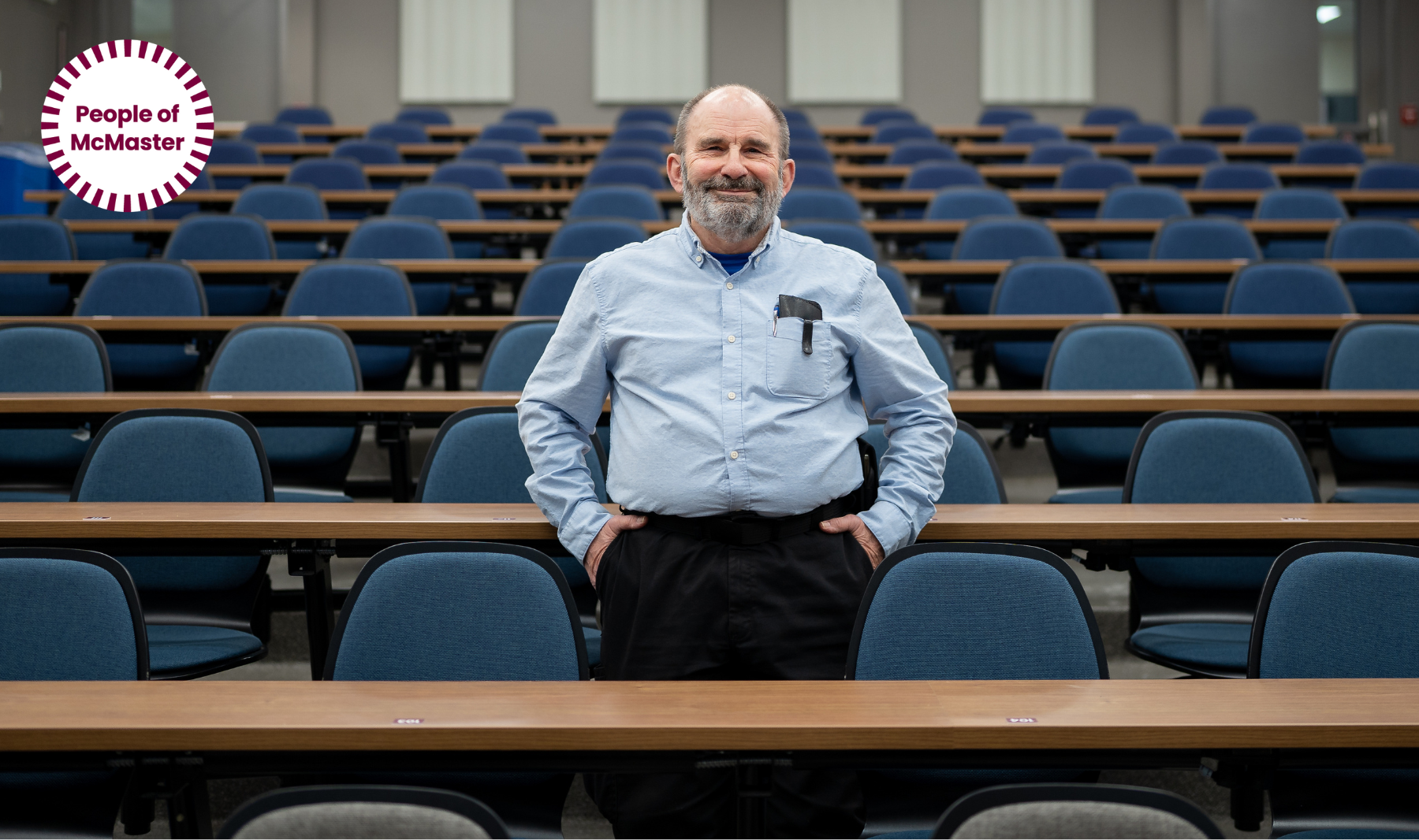
When Kevin Andrews arrived at McMaster on May 20, 1980, classrooms looked — and sounded — very different. Over the next 45 years, he would support McMaster through every major wave of audio-visual technology, from turntables, slide projectors and three-quarter inch videotape to today’s computer-driven classrooms designed to support modern teaching and hybrid learning.
Ask him what’s kept him here this long, and a theme emerges: The people, the place, and the problem-solving. There’s always something new to learn — and rarely a dull moment.
Tell me about your role at McMaster and what a typical day looks like — and where do you sit in the university?
Right now, I’m in a career growth role as an AV/IT Specialist, specializing in project coordination for upgrading classrooms across campus. Our team is Campus Classroom Technologies (CCT) and we report in to Mills Library.
I also still hold my role as a Senior AV Technologist, which means I support the technologists on our team — helping troubleshoot issues, fixing things where I’ve got the experience, and stepping in when something major happens. I’m sometimes what I call the “fire putter-outer.”
Between those two roles, there’s usually never a dull moment. I can come in with a plan for the morning, and by the time I look up, none of those things are done because something urgent needed attention.
A typical day is a mix of supporting the team and keeping things running and then sitting down to do the planning for the next round of upgrades. I’m already planning for work we’ll be doing this coming summer, 2026.
How long have you been at McMaster?
I started on May 20, 1980. I’ve completed 45 years of service and I’m working on my 46th year now.
I’ve seen several additions added to buildings and new buildings go up. I’ve been involved with a lot of change in the classrooms and I’ve worked with many different faculty and staff over the years. Many have moved on, some are still here.
Every once in a while, you pass someone in the hall and they say, “Oh, you’re still here.” And yes, everyone, I’m still here.
What did you do when you first started at McMaster?
I started at the time in AV Maintenance as a bench repair technician. I fixed anything at the university that was audio-visual related: turntables, cassette decks, overhead projectors, DVD players, slide projectors, movie projectors — you name it.
I was also the backup video repair technician, and at times I supported TV production. We had a full TV studio on campus at one time, and we did recordings for teaching, including content for a large first-year psychology course. The recordings would go onto videotape, and students would go to the Learning Resource Centre in Thode, request the lecture they needed, and watch it at a monitor to take notes.
It’s a completely different world now, but back then it worked and it was part of how students learned.
You’ve lived through decades of tech change. How have you kept up?
In the early years, it was more on-the-job learning. Something new would arrive and you’d look at it and think, “Okay — this is different.” The internet wasn’t what it is now, so it meant tracking down user manuals and service manuals and reading your way into it.
Now, information is much easier to access. You can look things up quickly. Often, if there’s a problem, someone else has experienced it already and posted a solution somewhere. Vendors and manufacturers also tend to have strong troubleshooting resources online.
One of the big differences is that we used to fix things on-site. Nowadays, it’s often replacing a major internal component or recycling the unit and buying new equipment.
How has your role changed over the years and what kind of classroom technology are you working with now?
After about 12 years, I moved from Maintenance into Technical Services Classroom Support. That meant being in the classrooms, making sure technology was working, and supporting faculty when they needed help with demonstrations or connecting devices.
Then around 2009, I started taking on project co-ordination work as well, and since then my role has been a mix: hands-on support, troubleshooting, and planning/implementing new classroom technology.
Over the years, I’ve also been involved in early video conferencing. Back when it wasn’t an app on your laptop, you had to physically go to a dedicated room with equipment to do video conferencing or teleconferencing.
We’re also working to keep pace with how teaching has changed — especially the expectation that classrooms can better support virtual participation through platforms like Teams and Zoom. The goal is to transition technology carefully so it’s as usable and standardized as possible for instructors.
What’s kept you at McMaster for 45 years?
The people — students, faculty, colleagues. It’s always a learning environment. Technology is constantly changing, so there’s always something new to learn and experience.
I’ve also been fortunate that even though I’ve been in the same overall department, I’ve had different roles and different experiences within it. It hasn’t felt like doing the exact same job for decades.
And the commute helps. Living in Burlington, I’m often travelling in the opposite direction of Toronto traffic.
Is there a moment or a project that stands out for you?
There are probably too many to count, but one highlight that comes to mind is the classroom technology work connected to the opening of the Peter George Centre for Living and Learning around 2017/2018. That was one of the earlier opportunities where I felt like I could make better recommendations on how technology should be implemented in classrooms.
I’ve also always tried to say “yes” when new opportunities come up. My father taught me a long time ago that “no” shouldn’t be in your vocabulary — because you never know what it’ll lead to.
A lot of it is similar in terms of categories — projectors, displays, computers — but everything is far more computerized now. When something goes wrong, you’re less likely to fix a smaller piece and more likely to replace a major component or replace the unit entirely.
What does it take to upgrade a classroom?
After all the planning, co-ordination between AV Integrators and McMaster Facilities with budgets in place, to do a proper upgrade, you need to be physically in the room. From removal of the old technology to installation of the new, including final commissioning, it usually takes seven to eight business days, often 10-hour days, in each room.
When classes are in session, we don’t have the same access — so a lot of the time we’re running into rooms during short windows between classes and doing quick fixes to keep things operational. Then, during breaks — like exam periods, reading week, and especially from April through summer — that’s when the major repair work and upgrades happen.
What do you like to do outside of work?
My main hobby is amateur radio (ham radio). I got my certification (licence ) in 1991, so I’ve been doing it for more than 30 years.
I focus on two areas: repeater work, which involves setting up remote radio stations at higher elevations to extend communication range, and community and emergency service. I’m a volunteer emergency co-ordinator for the Amateur Radio Emergency Service (ARES) for Halton Region and assist in the Hamilton area.
One example that stands out was during a major ice storm a several years ago, when some commercial communication networks went down. Our group was called in by the local municipalities to help support communications. We had volunteers stationed at warming centres and shelters, and we worked with organizations like the Red Cross and Salvation Army to provide communication links back to emergency operations centres and other served agencies.
When traditional systems aren’t available, amateur radio can still function — and that can make a real difference.
A lot of people picture amateur radio as an old-fashioned hobby — and some of that still exists — but the technology has evolved. It’s now attracting younger people and continues to play an important role when reliable communication really matters.
What’s next for you?
My wife and I have been talking about retirement for a couple of years now. We haven’t nailed it down completely — but at some point, it’s just about pulling the trigger.