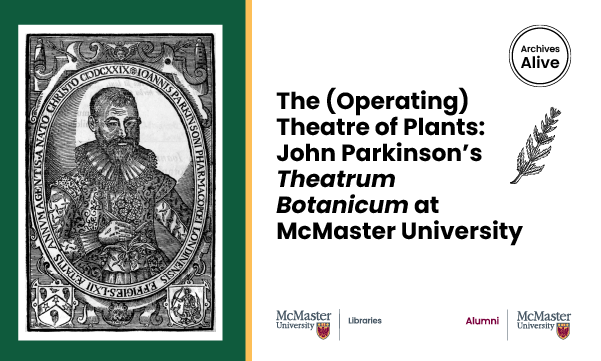
When a newly acquired rare book on botany arrived at McMaster University Libraries, it was clear that significant restoration would be required.
The first edition of Theatrum Botanicum, published in 1640, was groundbreaking for its time, featuring more than 2,500 illustrations of every medicinal plant then known to English pharmacology. As a widely used reference work over the centuries, the book sustained considerable damage.
The acquisition of this remarkable volume and its subsequent “book surgery” are the focus of an upcoming Archives Alive talk, The (Operating) Theatre of Plants: John Parkinson’s Theatrum Botanicum at McMaster University. The virtual event, scheduled for Nov. 26, 2026, at noon EST, is free and open to the public.
The presenters, Myron Groover, archives and rare books librarian, and Bronwen Glover, archives and books conservator, both at McMaster University Libraries, worked on the front lines of the project.
We spoke with Groover and Glover about the importance of Theatrum Botanicum, the clues its condition provided about how it was used over the centuries, and the conservation work undertaken to restore the book for future generations.
What first drew McMaster to acquire a 1640 first edition of John Parkinson’s Theatrum Botanicum?
MG: We have a long-standing collecting initiative to seek out rare books relating to botany, horticulture, and plant-based pharmacology — this is a growing area of strength for our collection! We had already acquired John Parkinson’s Paradisi in Sole, his earlier work on gardening, and I was very excited when a copy of Theatrum Botanicum — Parkinson’s late-career masterpiece — became available for sale. It sits at a perfect intersection of chronology, geography, and subject matter, and it includes thousands of beautiful illustrations, so it was an excellent candidate for acquisition. It was also the last of the great English herbals — really, the last of the great herbals in general — so it attests to a crucial moment in the history of plant study.
BG: This book was acquired shortly before I arrived at McMaster. It was perfect timing for me as staff were quite excited about the acquisition and were keen to use it in the teaching program and to make it available for researchers. This meant it was on the priority list for conservation treatment, and this project was one of the first major treatments that I did for Research Collections. It was a fun and engaging way to start my time here. The sheer size of the volume meant that it was not a straightforward treatment! Coming up with a plan involved a lot of thoughtful discussion between myself and Myron about what was possible and what was appropriate in terms of intervening with the originality of the book to make it a useful object again.
Myron, the title Theatrum Botanicum translates to “Theatre of Plants.” What does that title tell us about how Parkinson understood and presented botanical knowledge in the 17th century?
MG: In the 1640s, the term “encyclopedia” was not yet in widespread usage — so Parkinson is taking his inspiration here ultimately from the Greek word theatron, which means “a viewing-place" — but which also carries the vernacular meaning of a place one sits to view a play or a show. In this sense, a “theatre” is a comprehensive, wide-ranging overview; it’s a place one may sit and survey the whole of a discourse, a subject, or a phenomenon. It’s a way for Parkinson to claim, in a very brief and very poetic fashion, that he has set the stage for the viewer with the whole array of possible knowledge about plants.
When you first examined the copy acquired by McMaster, what evidence did you find about how generations of readers had used and interacted with the book over the centuries?
MG: Right away, even from the sale listing, it was clear that the book possessed a contemporary binding — “contemporary” meaning a binding that has accompanied the book continuously since the years just after it was printed, as opposed to having been rebound during the intervening centuries. That means the binding itself, as well as the text block, are both time travellers from the mid-17th century. Just because it wasn’t rebound doesn’t mean it wasn’t used, though; it was loved almost to death! So we had to think carefully about how to adjust for some of the wear and tear it had incurred over 400 years of appreciation.
BG: We can decipher so much about how a book was used by looking at clues on the binding. Our copy of Theatrum has elaborate gold decoration on the spine in a style that is just about contemporary with the text. This tells us that the book was highly valued by the owner, who would have paid extra for those flourishes. The fragile state that the book was in when it came to us also indicated that it was truly consulted and used by previous owners. The leather on the spine was split down the middle, indicating a “preferential opening” where the book was opened repeatedly. We can tell that this book was valued for its contents and didn’t lay idle on a shelf.
Bronwen, you've described conserving this copy as a form of “book surgery.” What were the key challenges involved in the repair process?
BG: In conservation, we generally try to follow the rule of minimal intervention. We want to maintain objects in as original a state as possible. This book is about 11cm thick, which causes a lot of strain on the spine when it opens. Originally, the leather was adhered directly onto the spine of the textblock. Over hundreds of years, the leather has lost its flexibility and trying to return it to its original state wouldn’t solve the problem of repeated stress. I did some research and found a method designed by a conservator at the Bodleian which changed the structure of the binding to support the leather and allow it to remain convex when the book is opened, rather than forcing it to curve inwards with the spine and repeating the original damage.
Plant fragments were found in this volume. How did they influence your conservation approach?
BG: Designing solutions and discussing treatment possibilities is always one of the most fun parts of the job for me. Myron and I discussed possible approaches to dealing with these fragments, which are quite brittle and vulnerable. The decision we settled on was that I would document the location of each piece within the book and store them separately in a compartment within the greater housing for the book. This way future researchers can cross-reference where they came from and potentially discover if they correspond to the pages they were extracted from.
MG: The presence of plant fragments in a text all about botany and pharmacology is very exciting, but it also raises so many questions: what plants are present? When and where did they grow? Do they correspond to the content in some way? We may or may not be in a position to answer those questions immediately, and we also have to be alive to the fact that future scholars may possess analytical tools we can’t even imagine today. So making sure that we preserve that evidence so as not to lose it, while still keeping the book usable, can be a challenge that requires some creativity. Fortunately, Bronwen is a bit of a genius for that sort of thing!
As specialists in rare books and conservation, what do you hope members of the McMaster community and public will take away from this Archives Alive presentation?
MG: A common theme in our teaching and outreach work is the idea that rare books are deeply human objects — they reflect the labour of minds and hands just like ours. So we hope that viewers will leave with a sense of the through-line of humanity and creativity that connects 1640, when the book was first printed, with the present day. We hope they will leave curious to learn more, not only about book history, but about the green growing world around them! And we hope that they will remember Research Collections as a friend in that sense of enquiry and curiosity.
BG: I hope that people enjoy a behind-the-scenes, in-depth look at the many lives of a book. I always find it interesting to think about all the people involved in the production, use, and care of a particular volume and I love finding clues that point to evidence of use and tangible links to past engagement with an object. It’s important that people remember that these books are here for everyone to use, they don’t become stagnant when they join our collection. Books are much more than words on a page and being able to interact with the physical object is really valuable.
Register for Archives Alive
Register for Archives Alive on Nov. 26, 2026
About Archives Alive
Archives Alive showcases the unique holdings of McMaster University Libraries’ William Ready Division of Archives and Research Collections. A wealth of resources exist which will delight and inform, from rare books created before 1800 to contemporary writers’ archives. Recognizing that archives can feel intimidating, these talks allow staff and researchers to share their knowledge with the community and introduce collection items housed within the library. Archives Alive is presented by McMaster University Libraries and McMaster Alumni.