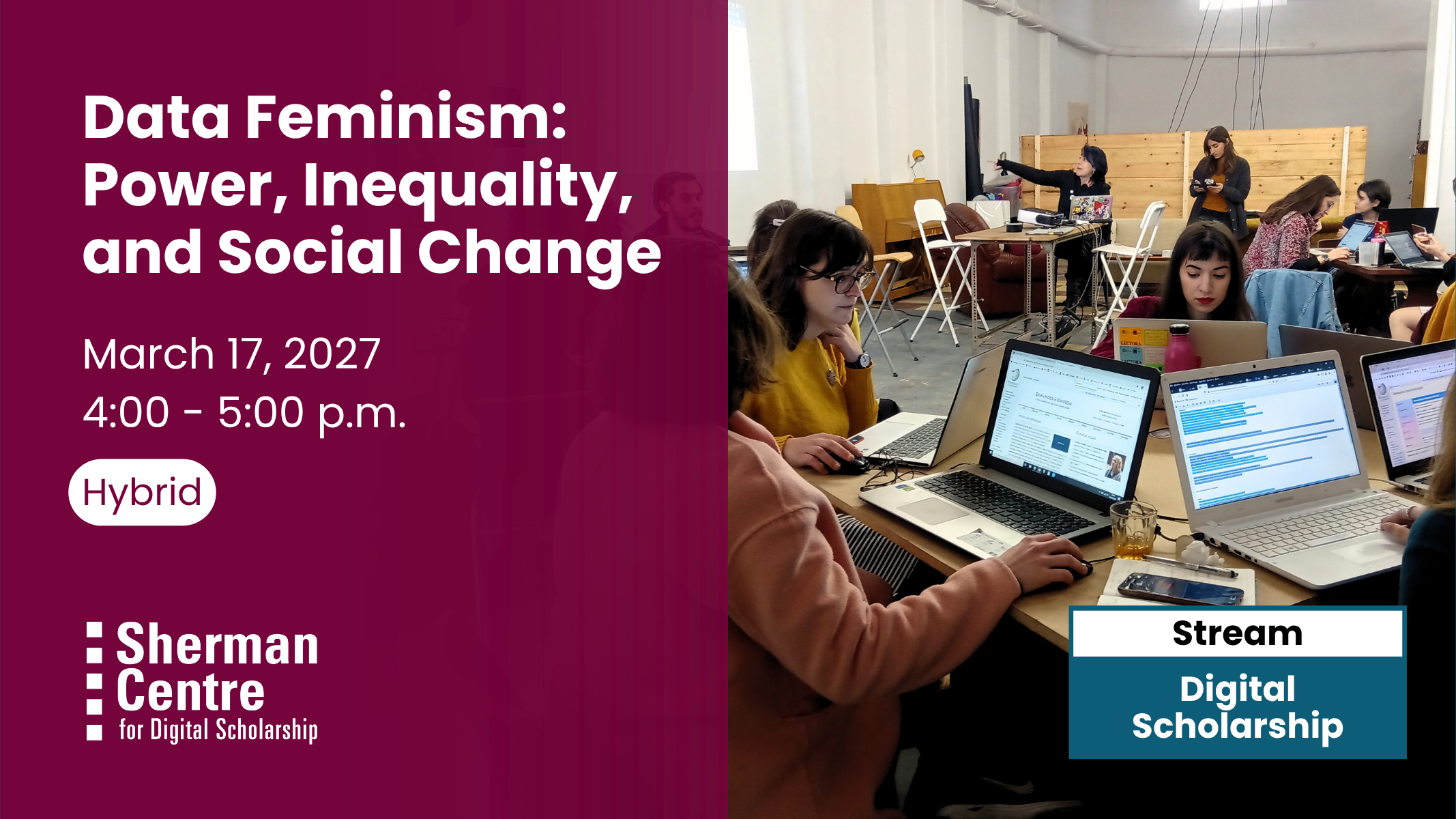
March 17, 2027 04:00 PM to 05:00 PM
Who gets counted, who gets excluded, and who benefits from the stories data tells?
In this workshop, participants will be introduced to Data Feminism, which Catherine D'Ignazio and Lauren Klein describe as "a way of thinking about data, both their uses and their limits, that is informed by direct experience, by a commitment to action, and by intersectional feminist thought" (2020). Together, we will explore how data practices can reproduce inequalities related to gender, race, sexuality, disability, class, age, geography, and other intersecting systems of power, as well as how data can be used to make those inequities visible, challenge unequal distributions of power, and support social change. Tying an understanding of inequality to a commitment to action, we will introduce data practices that can help make equality a reality, including Mel Mikhail's proposals for data management in feminist research projects. Through an introduction to the principles of Data Feminism, participants will reflect on how these ideas can inform their own research, teaching, community engagement, and advocacy efforts.
New to Data Feminism? No problem! This workshop is designed for anyone interested in learning how data can be used to challenge inequities and support social change. Researchers, educators, students, librarians, staff, and community members are all welcome.
By the end of this session, participants will be able to:
- Describe key principles of Data Feminism.
- Explain how systems of power shape data collection, interpretation, and use.
- Identify opportunities to use data to amplify marginalized perspectives and advance social change.
- Reflect on their own data types and what kinds of biases and ideological beliefs inform them.
Details: Any preparatory work for the session can be found on its information page. This virtual workshop will be recorded and shared on the same page, and discoverable via the Sherman Centre's Online Learning Catalogue.
Certificate Eligibility: This workshop is eligible for the Sherman Centre's certificate program. For more information, visit scds.ca/certificate-program. It is also eligible for the Canadian Certificate for Digital Humanities. To learn more, visit ccdhhn.ca or contact scds@mcmaster.ca.